12 March 2012

Mass Effect 2

If the original Mass Effect was a prototype for the game it should have been, then Mass Effect 2 is the full realization of everything the first game should have been.

It's obvious right from the beginning that Mass Effect 2 is a much more emotionally ambitious story than its predecessor. While the overall plot with the Reapers seems to be on hiatus for most of the story, this new tale has a bit more character depth, along with greater attention to detail and realism. When things happen in this game, you actually care.

The feel of the game's world is remarkably realistic. Whether at a maximum security prison, an alien nightclub, or an insectoid spacecraft, everything just feels right. Every audio and visual element comes together to craft worlds that the audience can believe in.

Instead of the sparkly-clean altruism of Mass Effect, Mass Effect 2 deals more with the seedy underworld elements of the Mass Effect universe. Instead of the Enterprise from Star Trek: The Next Generation, think Jabba's palace from Return of the Jedi. It's very much a "dirtier" and less morally clear-cut story. Indeed, sometimes it makes more sense to play this story as a renegade than a paragon, since many of the alliances you forge are with the morally-corrupt, and there's definitely an attitude of "the end justifies the means" for much of the game.
This rougher attitude is even represented in the way the game plays. The combat is far, far improved. In fact, it feels like it's not even the same game. Instead of being RPG combat with a shooter interface overlaid on top of it, now it's straight-up shooter combat with RPG elements enhancing it. There's no more worrying about loot or stat-tracking; nearly everything is streamlined here and it's wonderful. The guns even have a traditional ammo reloading system instead of the previous game's overheating system, which really helps things to feel more visceral and less annoying. On top of that, the game runs at a solid 30 FPS. It all comes together to make combat that's honestly better than many top-level third-person-shooter games out there.

The fact that combat is only one part of the gigantic Mass Effect 2 experience is one of the things that makes it so great. After all, movies aren't just one two-hour action scene (usually); there's more to it than that. Were ME2 all action, all exploring, or all dialogue, it could get boring. This game never gets boring. It finds a near-perfect balance of every kind of element you'd want in an interactive story.

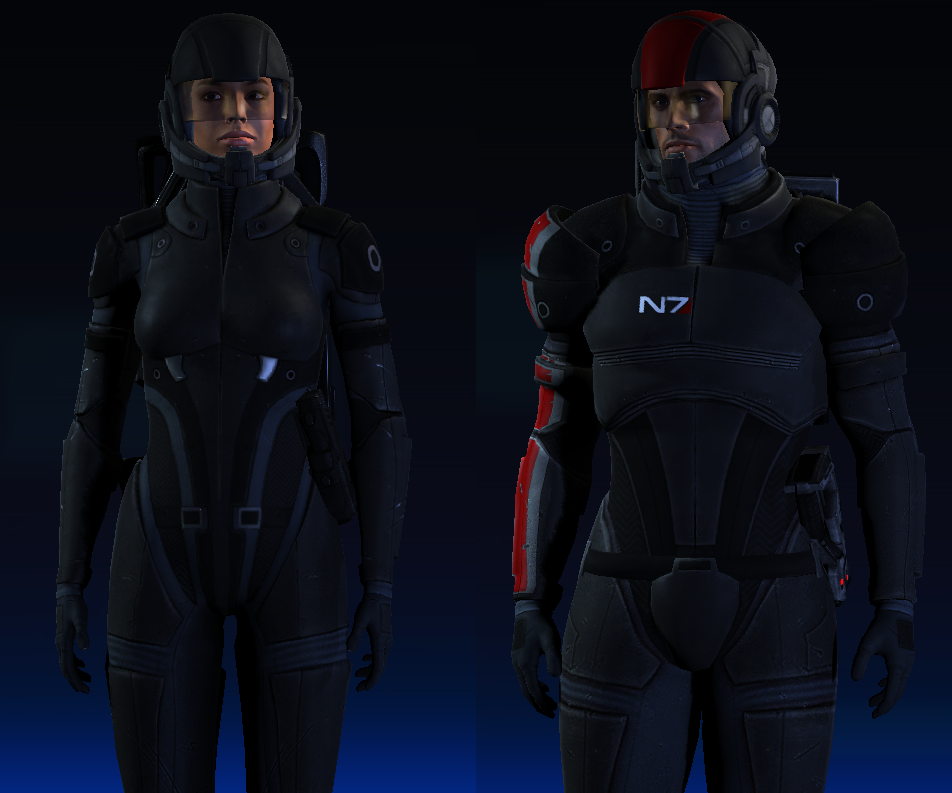
Going along with the newer, more aggressive tone, Shepard gets new armor. In the first game, Shepard's default armor looked like black space pajamas. His new armor in Mass Effect 2, however, looks like actual armor, while still carrying over the few elements that really worked in the first place.

The characters in general are far better-written than before, with a ton of added depth. It's partially because the writers seem to know how to write the characters better, and partially because the returning characters from Mass Effect have had two years of in-universe time to grow. However, the new characters vary in levels of depth. Few of them are particularly amazing, and most are just "there." In fact, it could easily be said that most of the characters are superfluous. There's a total of twelve squad member characters, far more than necessary. It might have been better for the game to focus down on perhaps only six squadmates, as in the first game.

As said before, this game focuses not so much on the overall plot with the Reapers, but on a new plot with a new enemy, the Collectors. As the story goes on, Shepard learns that everything is more closely connected than it initially seems, however, the fact remains that most of ME2's story is self-contained and somewhat tangential to the ongoing story of the game trilogy. What's even odder is the fact that Shepard is working for "the bad guys" in this story, fighting an even more dangerous enemy. While the game makes a decent case for why Shepard does this (it boils down to "the enemy of my enemy is my friend" and "we need all the help we can get"), there isn't a choice given to the player in the story, and it feels obviously wrong. It might make a certain level of sense for a renegade Shepard, but not for a paragon or neutral Shepard.

In general, the graphics are much, much improved. There's still some weirdness with characters' faces and hair, but it's not enough to be a real bother. The fact that the game runs at a solid 30 FPS now is great, as are the upgraded textures. The dialogue sections are much more lifelike, with characters doing more than just standing still and delivering lines. Now characters actually move around and gesture as they talk, making them feel more believable.

Unfortunately, there's a major problem with the way that the game displays text on a standard-definition screen. Not only is it extremely tiny, but there's not very much contrast. Most everything is in different shades of orange, or occasionally green. Since I played the game on a standard-def TV, I sometimes literally could not read what was on-screen and had to guess. Once or twice, this meant that I chose an incorrect option and had to reload a previous save file. It honestly is a huge problem since so much of the game is text-reliant. Still, though, it's a testament to the game's brilliant design that I was able to play, finish, and greatly enjoy the game despite only barely being able to read anything.
Seriously. Can you read this?

Mass Effect 2 is easily one of the best games ever made. It might not reach the very top, but it's extremely close. The few technical issues are far outweighed by the great visual design, and although the overall story and new characters may be a little bit underwhelming, they're at least decent. The level of quality put into the feel of the game is outstanding, and the overhauled combat is insanely fun. All these elements come together in the end to make one absolutely incredible experience.

9/10


DLC:


Kasumi: Stolen Memories
This is a fun little side mission. It feels like equal parts heist movie, spy thriller, and action blockbuster. As expected, the new squad character, Kasumi, isn't all that important to the main story, and generally stays out of the way of the entire main plot until the ending, where she serves only a minor—and unnecessary—purpose. This is a decent bit of fun, but, as stated, unnecessary.
7/10


Overlord
This one has a great classic sci-fi plot, but the actual gameplay is more time-consuming than fun. It's just too long.
5/10


Lair of the Shadow Broker
This should be upheld as the prime example of how to do story-based DLC properly. Not only is it a lot of fun, but it gives Liara the most character development she's ever had. Actually, it gives Liara more development than any other character in the entire main game. Provided that Shepard romanced Liara in Mass Effect, there's a ton of new relationship stuff that can happen here, and it's all well-written. In fact, everything in this DLC is well-written. There's plenty of great banter between the characters, some extremely well-choreographed cutscenes, and a plot twist that genuinely surprises. This is probably the pinnacle of storytelling quality in Mass Effect 2 as a whole; the fact that it's DLC makes it all the more notable.
10/10

08 March 2012

Mass Effect


Mass Effect is a game with some really revolutionary ideas, but not the best execution. It's a hybrid RPG/shooter, but the RPG elements far outweigh (and outperform) the shooter elements. For the most part, this game plays much like Bioware's previous RPG space epic, Knights of the Old Republic. In fact, shooter combat aside, much of this game's structure is nearly identical. The fact that ME is based on that tried-and-true formula helps it greatly, but the newer elements almost entirely fail.

In Mass Effect, set 270 years in the future, you play as Commander Shepard, the first-ever human selected to be a "Spectre" (sort of like a cross between a commando and a Jedi). Shepard traverses the galaxy searching for a way to stop Saren, an insane Spectre who is attempting to bring apocalypse upon all sentient life.

Most of the gameplay revolves around traveling to different planets, exploring various areas, talking to people, and occasionally getting into some fights. The real crux of the game, though, is the focus on choices.

Choices that the player makes in the game affect whether he gains "Paragon" or "Renegade" points. Paragon is generically good or diplomatic, while renegade is aggressive and self-serving. Gaining more points in one or the other will yield various rewards. Separate from the Paragon/Renegade meters, however, the choices you make in the game yield incredibly powerful results. Major characters will live or die depending on the choices you make, and by the end of the game, the galaxy will be forever changed because of you.

Dialogue is probably the biggest and most important aspect of the game, as that's where the decisions are made. Mass Effect's dialogue system has a dynamic camera that makes cuts that mimic the shot/reverse shot technique used in film, allowing for much more engaging dialogue. As if that weren't enough, the entire game is voice-acted, leaving nothing to the imagination as far as voice is concerned.

The Mass Effect universe is great. It's got a wonderfully sleek visual aesthetic, with a great deal of thought put into the background of each and every character, alien race, and new technology. There's even a codex of information put into the game's menu just in case you feel like learning everything there is to learn about the universe, regardless of its actual importance to the plot. It's that kind of detail that really makes this game feel like it's something special, despite its flaws.
Speaking of those flaws, there are many. The shooter mechanics are flat-out abysmal. Everything from a barely-working cover system to completely ineffectual controls over your squadmates plague this game. As if that weren't enough, the RPG mechanics of the game overtake the shooting to such a degree that it doesn't even make sense as a shooter. For example, there are four separate accuracy stats for weapons: your personal accuracy skill stat, your accuracy skill stat with that weapon, the weapon's built-in accuracy, and your actual skill as a gamer. Shockingly, the last of those four is seemingly the least-important. You can have your reticule aimed squarely on an enemy's head, but if you don't have all your stats in the right place (which it's almost guaranteed you won't until late in the game), you will miss a great many of the shots you fire. So, essentially, you're playing as a supposedly-amazing hero who can't aim correctly, can't take cover correctly, and can't interact with his teammates effectively enough to make up for any of that. While being extra-careful in combat can help you greatly, that doesn't make up for the fact that the game basically takes control out of your hands when, as a shooter, complete control is exactly what you should have. It feels as though Bioware designed the game to be a traditional real-time turn-based game, but tacked on shooter mechanics. So instead of combat being fun, the shooting only makes things more difficult than necessary.
There's also an issue in that you spend a ridiculous amount of time picking up loot, including all types of weapons, armor, and upgrades. The problem with this is that you can literally pick up thirty different versions of the same gun, all with slightly different stats. This means that you end up doing a lot of organizing and cleaning out your inventory, as well as maximizing your stats just to make sure your gun works correctly.

The graphics are both great and problematic. The Unreal Engine 3 is used rather well here, not looking at all like other UE3 games. There's an optional film grain filter that's put over the game by default, which really adds to the cinematic feel. The aforementioned sleek style of the ME universe looks great, with vivid lights glistening off metal surfaces. Details like player movement are also more realistic, with Shepard having a bit of inertia to deal with as he moves throughout the game world. On the negative side, the texturing is a bit simple and bland, making characters' faces look a bit overly smooth. The framerate in the game is also pretty bad, hardly ever reaching 30 FPS, and usually staying down in the 20s at most. As if that weren't enough, there are a ton of glitches, many of which require you to revert to a previous save.

That's another thing: the save system. There's an auto-save system, but it doesn't save often at all. If you don't constantly save manually, you'll spend a lot of time replaying the same sections over and over again. It's very frustrating.

Another problem is the oddly dispassionate story. While the overall plot is very good, there's not very much genuine emotion in it. The characters don't generally have much of a personal stake in the events; they're just "there." While Mass Effect's story is definitely interesting and at times astonishingly epic, it's sometimes hard to care about.

The characters are all well-realized, but there are definitely some oddities. First of all, three of the characters can be pursued as romantic interests, but this comes off as being a little abrupt. Although you're supposed to have formed some kind of deep bond with the character you decide to be with, you can romance that character after literally two or three conversations. Unlike KOTOR, where you could have a dozen different conversations with every character, getting to know his or her backstory and developing a relationship that seemed somewhat genuine, here relationships seem to spring out of nothing, and feel shallow.
Despite all these flaws, there is one gigantic saving grace: the ending. This is where all the problems with the game seem to melt away. The story gains a bit of emotion; the gameplay feels tighter and more responsive; the overall package is just better. It's easily one of the best finales in gaming history, and even worthy of being put alongside the best Sci-Fi film finales.

Mass Effect feels a bit like a prototype of a different game. It's got a lot of bugs, design flaws, etc. However, all in all, Mass Effect is a game with a ton of promise, and though it doesn't always live up to that promise, few other games even attempt to reach the levels that Mass Effect does. For that reason, while Mass Effect definitely stumbles along the way, it's still something truly special.

8/10


28 December 2011

Halo: Combat Evolved Anniversary

A modern remake of Halo: Combat Evolved is the perfect way to celebrate the 10th anniversary of Halo. Combat Evolved Anniversary is a near-exactly-recreated version of the original game with a new layer of HD graphics put over it.

Overall, this is a brilliant package. For only $39.99, you get an entirely remastered CE campaign with new visuals, new sound effects, and re-recorded music. On top of that, several CE multiplayer maps are included in a downloadable (and playable on-disc) map pack for Halo: Reach's multiplayer, complete with tweaks to Reach's gameplay to help recreate CE's multiplayer as closely as possible.

The single-player campaign is, overall, a very good recreation of CE. The gameplay hasn't been altered in the slightest, except for now being rendered in 16:9—allowing for the widest field of view in any Halo game yet. Even the glitches in the original game still work. Sometimes, this is cool. It's always neat to find those hidden tricks you used before and discover that they still work. On the other hand, this can also be frustrating. The crouch toggle function, for instance, literally does not work because of a bug in CE's game code.
The reuse of much of the CE code creates a lot of problems, actually. Although CEA adds online capability to its co-op campaign, CE's code was not designed for that kind of use. Because of that, there is HORRIBLE lag between players, to the point of severely affecting the gameplay. The new graphics layer doesn't seem to help; it seems like the Xbox is being stressed by essentially running two games at once. Sometimes in order to counterbalance the lag, it becomes necessary to switch to classic mode and stay there—which kind of defeats the purpose of this game, doesn't it?

As for the new graphics themselves, they're a mixed bag. The real strength of the new look is the environment. Everything in the Halo world looks gorgeous. There are a few little oddities with the art direction choices, mostly with the choices in color, but overall things look amazing. If there's one criticism to level at the art in the environment, it's that it's over-designed. There's more vibrant detail than actually needs to be there.

The Halo ring itself (when viewed from space, in the main menu or the cutscenes) looks really bizarre, being more purple in color and given a ton of prong details that seem bizarre and distracting. Like the ring is going though a weird phase in high school where it's just gotten a dozen piercings and you're not sure you recognize it anymore.

The character and weapon models are sometimes brilliant, but sometimes terrible. Master Chief himself, following the example of the rest of the game, looks a bit more colorful, and his armor is actually made a little bit rounder than it was in CE. Personally, I'd have preferred it if they'd kept the original design exactly and simply made it more detailed, but as it stands, John-117 looks pretty spiffy. Other characters, however, look a little weird. Some models, like the UNSC marines and Captain Keyes, use old models from Halo: Reach. This makes total sense, and I like it. Cortana, however, uses the model from Halo 3, which is nothing at all like the CE design. Even worse, she wasn't given any new animations—unlike some other characters—so she seems horribly awkward in every possible way. Considering that Cortana is, in terms of story, the heart and soul of CE, this is very disappointing.

Some of the weapon models are new, while a few are re-used from older games. The worst offenders are the assault rifle, taken from Halo 3, and the shotgun, taken from Reach. The assault rifle looks close enough that unless you're looking for it you won't notice the difference, and hey, maybe this is a purposeful retcon. 3's version of the AR does look better anyway, and there are more than a few real-world guns that look exactly the same on the outside but function differently. The Reach shotgun, on the other hand, looks nothing at all like the CE shotgun. It's perplexing as to why they didn't just re-use the Halo 3 shotgun, at least, since that one looked more like the CE shotgun.

There are other differences, too, but those are the main ones that bugged me the most. Hardcore Halo fans will definitely notice these re-uses of old Halo assets, and, if they're like me, will be pulled out of the experience by it. It just feels like the development team used old models like duct tape covering the bits of the game they didn't have time to finish. It's very disappointing.

One way in which the game does not disappoint is the way that it brings together the new audio and visuals during gameplay. Every bullet slams into its target with vivid response, aided by the amazing new sound effects for weapon fire. The old pistol had a "bap" sound effect in CE, but in CEA it's a thunderous "BOOM" that makes the gun sound as powerful as it actually is. When enemy shields fall, they don't just fade out; they explode. It's immensely satisfying to snipe a jackal and watch his shield pop like a liquid firework. That kind of visual feedback in combat is something that CE always lacked in comparison with future Halo games, notably 3, ODST, and Reach. Now that it's there, it makes CE all the better.

The multiplayer component of CEA, as mentioned before, is really just a map pack for Reach. But it's a hell of a map pack, easily the best one for Reach yet. Maps like Hang Em' High and Prisoner are wonderful, but Timberland—a map only Halo PC players had seen before—is easily the best big team battle map of all time. We also get a new firefight map based on a section of the CE campaign, which is very very cool.

All in all, Halo CEA is a little bit of a jumble. Some of it is above and beyond what it needed to be, while some of it is far below the Halo standard. Overall, however, it's a decent remake of an amazing game, with a great multiplayer add-on for another game that you already love (or should, at least).

And you get achievements now, so... yeah. Play it.

8/10

03 December 2011

The Legend of Zelda: Skyward Sword


Skyward Sword is in many ways a new genesis for the Legend of Zelda series. Not only does it provide a new beginning for the story, it's the only Zelda built from the ground-up for Wii, the first Zelda to finally include real motion-controlled sword combat, and the first to have fully-orchestrated music.


Story

This new story is set earlier in the Zelda timeline than any previous game, before the formation of Hyrule kingdom and before many other recognizable elements of the Zelda universe have come into being. Because Skyward Sword is set so early, there aren't any towns, villages, castles, or people to meet in the world beyond the single small town you begin your adventure in. The few characters you come across are rarely humanoid; they're closer to talking wildlife than anything else. Only a few of them could be considered friends to Link; most just act like talking signposts directing Link to his next objective. This makes much of the game largely impersonal and lonely, a sharp contrast to previous games like Ocarina of Time, which gave each area and dungeon a character (or cast of characters) for Link to get to know and care for, making the entire journey a very personal one. Here, Link is motivated only by finding Zelda and nothing else. Because of that, the story feels a little sparse. You need to complete three dungeons before each new step is taken in the main story, and many of those steps are very small. While this isn't terribly different from most other Zelda games, the fact that everything aside from the main story is so uninteresting doesn't really help.


What does help, however, is the fact that this game introduces and explains so many epic facets of the Zelda universe. For fans, getting to see some of the very foundations of Zelda mythology lain before our eyes is a special thing. At times, it's totally enthralling. Skyward Sword also has the deepest and most meaningful relationship between Link and Zelda seen yet. There may not be much actual story, but what's there is great motivation for players to continue on. Perhaps that's why some of the game's story is so disappointing: you desperately want to find and save Zelda, so every dungeon that doesn't end with you finding her is frustrating, and every new obstacle that gets thrown in your path (and there are many) is just maddening.


Gameplay

The aspect of exploration is practically expunged from the game entirely. Practically every single area in the game, save for the tiny home area of Skyloft, is an obstacle for Link, almost like some sort of mega-dungeon. The world of Skyward Sword feels less like a living, breathing place and more like a gigantic puzzle to work your way through. I found myself bored and frustrated with most of Skyward Sword's world instead of enthralled by it as in every other 3D Zelda game.

The puzzles in Skyward Sword, however, are fortunately brilliant. Beforehand, most Zelda games had dungeons that relied more on finding a hidden trick, and most games in the series used the same tricks over and over again. Skyward Sword, however, feels much more organic in its puzzle-solving, encouraging players to use their brains and realistically think about how they can use their tools to work their way past obstacles. I personally feel that although I didn't have as hard a time getting through Skyward Sword's puzzles as other games, I had to be much smarter about this game than other games in the series. It was less of "oh, I stumbled across the right answer" and more of "I logically figured this out." If there's anything Skyward does better than any other Zelda, it's puzzle-solving.

Playing as Link in Skyward Sword feels brand-new in a few small ways, but in many other ways feels like The Wind Waker 3. Although Ocarina of Time set up the basic gameplay that all 3D Zelda games have followed thus far, Skyward Sword—even moreso that Twilight Princess, which was also based on the same engine—feels like The Wind Waker. And while Wind Waker is an incredible game, it has definitely aged a bit. In today's gaming world, where games like Assassin's Creed and Uncharted show off incredible fluidity and ease of movement, Zelda still feels like it's lagging behind quite a bit. Maneuvering Link throughout the environment can sometimes feel like a bit of a chore. That wasn't as big of a problem for Wind Waker, with its more simply-designed worlds, but Skyward's world is a bit more complex.

Additionally, the art style of this game is notably set in-between Twilight Princess and Wind Waker, possessing Wind Waker's bright colors and a bit of its cel shading along with some of Twilight Princess's more realistically-proportioned character models. The end result works pretty well, but there are some sacrifices. The level of detail is nowhere near as high as Twilight Princess, and the level of stylization isn't as strong as Wind Waker. What we're left with is a bright, vivid muddle of outdated visuals. Even with such heavy stylization, a lot of the game (notably the textures) just looks distractingly old. Other Wii games have shown that this doesn't need to be so; games can look better.

Environment design aside, this game feels near-exactly like Wind Waker, albeit with the addition of new controls for the sword, the shield, and item aiming.


Sword and Shield

The sword controls feel like what Twilight Princess's controls should have been. Nintendo fans were promised something like this all the way back in 2005 when the Wii controller was first unveiled, then known as the Nintendo Revolution controller. The swordfighting bit at the end of that original teaser video left Zelda fans with their jaws on the floor at the sheer possibilities created by such a new controller. But when Twilight Princess was released, the sword controls hadn't actually been changed at all from the traditional button-press action we'd seen in previous Zelda games. They just mapped the button press to a controller shake, which only made things frustrating. Finally, with the advent of Wii MotionPlus and a Zelda game built from the ground up for Wii, that original idea has come to fruition. Players can now control Link's sword movements near-perfectly. Whenever a player swings the sword, the game registers which direction the controller is moving in and selects one of 9 different options (8 directions plus a stabbing motion). If you want to slash from left to right, you can do it. From right to left? You can do it. From left shoulder to right ankle? You can do it. And for the most part, it's highly accurate. Initially, on my first day of playing Skyward Sword, I was getting frustrated with the controls, convinced that it wasn't correctly interpreting my actions. The next day, however, I noted that my moves were much more accurate. It wasn't that the game had calibrated itself more correctly; it was that I had simply gotten better at using the sword. The game was actually interpreting my movements so accurately that my own error was showing up.

On the other hand, it's not as though my errors weren't understandable. One quirk of the Wii Remote is that it doesn't actually sense where the controller itself is in three-dimensional space or how it moves, like PlayStation Move or even the Kinect. The Wii Remote just senses vaguely how it's being tilted and moves, and estimates what's going on. You can imagine it as though the Wii Remote is a person riding in a car and then being asked which direction the car is moving and how fast. It can be trusted within reason, but only so far.

One big problem with the sword controls is that they demand that the Wii remote stay perfectly horizontal while the sword is being swung, no matter the direction. It can be tilted up or down (as is necessary for vertical swinging), but not rotated along its axis. If you rotate the Wii remote even slightly while swinging, the remote will misinterpret the intended angle of the swing. The problem is that this is nothing like how a real sword works. A sword is only sharp on two sides; a swordfighter rotates his sword when he swings in different directions—otherwise he'd just be slapping his opponent with the flat of the blade. Link actually does this in the game when he attacks, regardless of the Wii remote's angle. But you don't need to be a swordsman to know that it doesn't make sense. You don't chop with the flat side of a kitchen knife, do you? That disconnect between the game and reality hurts the overall experience. Sword combat often still feels realistic and immersive regardless, but sometimes the holes in the realism can be a harsh reminder that the Wii remote is video game controller that needs careful precision, not a "real" sword. That said, it does work most of the time.

The shield controls are handled entirely with the nunchuk's motion sensor, and they work very well. All you need to to is shake the nunchuk once to raise your shield, and shake it again once there to knock back enemy attacks. This works in tandem with the sword controls, creating a fun sense of realism. Players see Link on-screen holding his sword and shield, and they get an instant sense of just how they're supposed to interact with the world.


Bow and Arrow

In Twilight Princess for Wii, you simply aimed the pointer at an object and hit the A button to fire. It was far too easy, in some cases allowing players to snipe enemies with arrows from miles away with pixel-perfect accuracy. Here in Skyward Sword, it's a little more difficult without feeling frustrating. Skyward uses the MotionPlus tilt sensor to aim rather than the Wii remote pointer, which means that it's measuring your 3-dimensional controller movement rather than the pointer's placement on the 2-dimensional TV screen. Realistically, this is how you'd really aim with objects in the real world, and it feels very natural. One particularly cool feature is the fact that you can use two different control methods for firing arrows: you can either hold down the A button and wait for the tension in the bowstring to build to maximum, or you can physically pull back on the nunchuk while holding the C button—as if pulling back an actual bowstring—thus instantly charging your arrow to maximum speed.


Sound

The music in this game is the best-produced of any Zelda thus far. Having a fully-orchestrated soundtrack makes a lot of difference. The themes in Skyward aren't as plentiful or notable as in Ocarina of Time, Majora's Mask, or even Twilight Princess, but what's there is good. Better yet, there's more emotion in those few moments of music than in pretty much any prior Zelda game.

One major way in which Skyward feels like an old game is the lack of voice acting. That worked fine for Wind Waker in the early 2000s, but even five years ago in Twilight Princess it felt odd. There's some controversy among fans (as well as the Zelda development team) about whether or not adding voices would make the game better. A lot of people say that adding voices would only make it seem odder that Link doesn't talk. Personally, I'm all for voice acting; it's one of the last things keeping the series from being totally immersive.


Finale

Skyward Sword, overall, is a slightly odd experience. On one hand, it feels completely vibrant and new. The fresh combat, imaginative puzzle-solving, and orchestrated music are definite high points. On the other hand, the game is horribly stiff at times, and in many ways it simply feels outdated. This game needed to be released five years ago, not now. At the same time, does that objectively make the game bad? No. After all, old games can still be good; it only matters if they pass the test of time. And Skyward Sword mostly passes that test. Yes, the outdated portions of it are drawbacks, but only to the point of mild annoyance. It's something that should definitely be corrected before the next Zelda game is released, but it doesn't mortally wound this one.

In the end, The Legend of Zelda: Skyward Sword is a great game. One drawback to the Zelda series is that its standard is set so high, it's easy to forget that even an average Zelda game is truly better than most anything else.

8/10

19 September 2011

Lego Harry Potter: Years 1-4

Anyone who's familiar with the Lego game series should know their basic formula:
Go from place to place, using various characters' skills to solve puzzles and defeat enemies, collecting all sorts of items and discovering new characters.

Anyone who's familiar with Harry Potter should know that story's tropes:
The heroes go from place to place, using various magical abilities to solve puzzles and defeat enemies, finding special items and meeting new people.

Clearly, this was a game that was always waiting to happen. Every element of Harry Potter translates into Lego so well that the game becomes totally immersive.

The music, taken directly from the film scores, works brilliantly. John Williams' themes are meant to be played in concert style, which fits the looping requirements of gameplay very well. The overall feel of the game often tilts more towards being a Harry Potter game than a Lego game, which actually works rather well. At the same time, it's infused with the fun of Lego—that being, essentially, building and/or breaking things.

This game is massive. Not only are there plenty of story-based missions to go on, but also a huge overworld in the form of Hogwarts Castle, which has an almost mind-boggling amount of hidden collectibles and secrets. Even with a guide, it takes around a week of nonstop gaming to find everything. Of course, once it's all done, then that's it. It's done. The fun of the game really is the discovery and collecting; once you've completed it to 100%, there's really not much reason to go back.

That being said, though, the perfect synergy between the "magic" of Harry Potter and the fun of Lego makes the overall experience a great one, even if there's a limit to how long it can last.

8/10

Prince of Persia: The Forgotten Sands


This is a decent game. A bit limited, but pretty fun. Extremely straightforward, but not in a bad way. With a nice, self-contained story that doesn't feel too long or too short, it makes for a great rental game. Might not match the brilliance of past Prince of Persia games, but it's still not bad on its own.

7/10

09 July 2011

Transformers: War For Cybertron


From start to finish, it's obvious that this entire game is made by and for Transformers fans. It evokes the same fun feeling of the 80s cartoon while being given a certain level of quality that makes it not as easily ridiculed.

Other recent Transformers games have tried to do various things with the franchise that didn't really work. We had the first two movie games, which tried a semi-open world mission-based style. We had an older game for the PS2 that was more along the lines of adventure-shooter. War for Cybertron is a simple action-shooter, and it works brilliantly.

The primary gameplay is a 3rd-person shooter, played from an over-the-shoulder perspective. This works very well for the most part, but can get slightly annoying because the camera is set several meters to the right of the player character. Other shooters give the player the option of switching the camera between the left and right sides on the fly, but War for Cybertron does not. This makes for a problem, since there's no way to  look around a corner to your left. If you're trying to hide behind cover, you can only really step around from the right side, not the left. Fortunately, the camera shifts to a centered perspective when you click the left thumbstick and transform into vehicle ("alt") mode. The act of transforming and quickly utilizing alt mode is one of the best parts of the game, especially when using a fast-moving "scout" character like Bumblebee or a jet-based Cybertronian like Starscream or Jetfire. While past Transformers games have made alt modes feel clunky and annoying, War for Cybertron makes them feel fast and fun.
The story behind the game is pretty simple: it's a prequel to the main Transformers story, set during the war on Cybertron. Megatron has discovered the power of Dark Energon, and is using it to corrupt the planet and destroy the Autobots. The Autobots fight back, and Optimus Prime must learn to accept his role as leader of the Autobots. One very cool factor is that this game serves as the canonical prequel to the currently-running Transformers: Prime TV series. The voice cast is different (with the exception of Peter Cullen's Optimus Prime), but there are plenty of notable similarities in design and story between the two projects.

The main campaign mode is split into ten reasonably long chapters. The first five are played from the perspective of the Decepticons, while the last five belong to the Autobots. Although the chapters are arranged in chronological order from I-X, they're treated like two separate campaigns, and the player can choose to start at the Autobots' first mission in Chapter VI if they so choose. It's a nice bit of leeway.

For the most part, the Decepticons' campaign is very straightforward: Megatron and his lackeys fight their way from point A to point B, blasting everything in sight. It's enjoyable, though a little mind-numbing and repetitive. The Autobots' campaign, however, is much more interesting. It's more varied, changing things up a lot more often and throwing in a few more minor plot changes to keep things somewhat interesting. Overall, the Autobot campaign is just more fun.
The multiplayer modes are good, if somewhat generic. All the usual multiplayer shooter modes are there: Team Deathmatch, objective-based combat, etc. The really great mode, however, is called "Escalation." It's basically a survivor mode, where four players defend themselves against wave after wave of Decepticon drones. The little features of this mode—inspired, no doubt, by the Nazi Zombies mode from Call of Duty—make it extremely fun.

Looking back at the last seven paragraphs I just wrote, three of them have ended with the word "fun." And that's probably the best word to describe War for Cybertron. More than any game previously, it taps into what we all suspected would be the fun of being a Transformer and fighting in the Great War.

8/10