(Orig. 2/15/11)
The first-ever modern Star Wars RTS is here. And it's pretty good.
I won't go into a ton of depth here, but suffice it to say that the game focuses on three basic types of gameplay: space battles, ground battles, and galactic conquest.
Unlike other RTS games, in which each battle is a wholly separate affair from the rest of the game, Empire at War interlinks every single battle of the game into one gigantic war for the entire galaxy.
All your troops, ships, and other combat units are trained/built under the galaxy map, but it's only once you send those units in to attack enemy forces (or if you are being attacked) that the traditional RTS-style gameplay begins. Here, you either attack in space or on the ground. You can choose to either play the battle through yourself, or have the computer "auto-resolve" the battle, instantly determining which units will die on both sides, and which side will end up the victor. More often than not, having the computer auto-resolve the battle will end up worse for the player than playing through the battle. Conversely, if the player's forces vastly outnumber and out-gun the enemy forces, the auto-resolve feature will often result in a major victory for the player.
One major flaw with the game is that the ground battles are tedious, boring, horribly slow, hard to control, and unnecessarily difficult. It's extremely tempting for the player to simply hit the auto-resolve button and take a major loss, if only to avoid spending a good 15-20 minutes trudging through the ground-based combat.
The space battles, on the other hand, are where the game really shines. The cinematic, fast-paced, and mildly strategic space battles are exciting, fast-paced, and lots of fun to look at. There's a ton of depth in these battles, due to the fact that all large ships and space stations have individual sections to attack. If you want to lower a Star Destroyer's shields, all you need do is eliminate its shield generator. If you want to stop a Rebel Cruiser from blasting away at your space station, target and blow away its turbolasers. By selectively destroying specific sections of ships and stations, you can turn the tide of entire battles.
There's even an option (in both ground and space battles) to switch to a completely cinematic camera view, which allows the player to simply sit back and watch the battle as though it were a Star Wars film. Sweeping camera movements and shaky-cam effects for large explosions make the experience one of the most breathtaking visual Star Wars experiences. There are some drawbacks, however. The cinematic camera often rests on the least interesting aspects of the battle, rather than what you want to see. Fortunately, a quick tap of the space bar lets you switch to a different angle, but it's still a pretty big problem.
The space battles, while still very fun, are not without their own flaws. The AI of specific units doesn't appear to know what to do in rather obvious situations.
For every unit on the side of the Empire, there's a unit on the Rebellion side to counter it, and vice-versa. Bombers kill capital ships, corvettes kill fighters, frigates kill corvettes, and capital ships kill frigates. However, the game doesn't seem to know that. At the beginning of each battle (and constantly in the middle of battles), you'll need to TELL each unit what it's supposed to to. If you lose track of one unit for a moment—which is easy to do with battlefields as big as the ones here—you might find that unit destroyed because it wasn't avoiding or attacking the right units. It would have been great if there were an option to give orders to each unit BEFORE each battle (tell X-Wings to attack fighters, tell corvettes to attack bombers, etc). This can be a nuisance, but it's not so bad as to bring the space battles down entirely.
It definitely can be a huge problem for ground battles, however, because a good portion of ground battles involve just searching for enemy structures. However, if you've ordered a unit to move across the map, he might not necessarily stop to battle every unit he meets along the way. So if you order a group of Rebel troopers to move to a corner across the map, but they meet a squad of stormtroopers along the way, the stormtroopers will simply mow the Rebels down without resistance. It can happen in the blink of an eye, too, so you need to keep a CONSTANT eye on your troops at all times. It's stressful and frustrating.
There's a distinct lack of strategy in ground combat, to the point where it often feels that both sides are merely throwing units at each other until the computer decides that one army has won.
The Galaxy Map section of gameplay might be the most well-rounded, as it allows the player to use smart economics and highly strategic placements of troops, stationary defenses, and production facilities to strengthen their forces. A masterful Galaxy Map-player can dominate an entire game, even by only using the auto-resolve feature.
Despite a few major flaws, Empire at War is an overall good experience, made far better if you're a Star Wars fan (as I am).
8/10
15 February 2011
14 January 2011
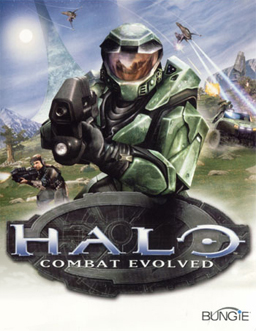
Halo: Combat Evolved
(Orig. 1/14/2011)
Halo. The game that made the Xbox what it was, and kept the system from dying in its infancy. The game that reinvented the concept of the console-based first-person shooter, and gave the few Xbox fans of late 2001/early 2002 a rallying point.
It's fun.
I'm not going to set up the Halo universe for you here; if you don't already know what it's about and you want to find out, go read it elsewhere. This is just about the game.
Halo: Combat Evolved is just simple fun. That's it. It's not overly gritty (though it has its moments), and it's not highly realistic. It's just a very fun sci-fi shooter with a great co-op feature and an awesome multiplayer component.
Bungie's greatest strength isn't necessarily in their ability to alter genres or create entirely new ones, but rather to refine what's already there into a distinct, polished, simple experience. The nearest comparison I can make is with Nintendo and their level of refinement.
The story of Halo is good, though many basic (major) elements of the Halo universe are missing. There's no in-game explanation of what exactly is going on, why humanity is fighting an alien race known as "the Covenant," or who exactly this "Master Chief" is. That might work to the game's advantage, since there's no exposition to get in the way, but it definitely does make the player feel a little bit "out of the loop."
Of course, once the opening mission is completed and the story moves down to the surface of the Halo ring, the player is—figuratively and literally—"in the loop." The player is privy to all the details of the on-ring storyline, and there's nothing you need to know that you don't.
One thing that is a bit of a problem, however, is the way that the game sometimes doesn't do much to guide the player through the world. Many of the environments in the game are vast and repetitious, often lacking clear markers for the player. If you get turned around in a few areas, you might just have to figure out where to go through trial-and-error. Another rather odd feature of the level design is that the path for the player might be not-easily-spotted.
Imagine you're in a hallway. There are fifty doors in this hallway, but only one of them is unlocked. In order to find the correct door, you need to get a good look at each door an find the one with a small green light near the handle.
Similar situations happen repeatedly throughout Halo. You'll be in a large room with tiny alcoves hidden behind catwalks, pillars, glass, and short walls. You need to search through all of that to find a single small doorway. And that doorway will be somewhere, not directly ahead, but slightly off to the side, where you might expect to find a broom closet.
Later games in the series solve this issue, but it's still somewhat frustrating here.
The weaponry in the game is another hit-or-miss (heheh) design feature. The primary weapon, the MA5B Assault Rifle, is so wildly inaccurate that it's only useful at short distances. It's really really useful at short distances, but that's it. In fact, almost all the weapons in Halo tend to favor the "fire in the general direction of your enemy" approach rather than the "be accurate" approach. Even the enemies themselves don't always respond correctly to direct weapons fire, due to inaccurate hit zones. If you shoot an enemy in the arm, you might hit their arm, or you might not. The best thing to do is just aim for their chest and hope for the best, unless you have a sniper rifle and a clear shot at their head. I wonder if perhaps this was done in order to better fit the lessened accuracy of the Xbox controller's analog stick? This actually ends up hurting the later-released PC and Mac ports of the game, as they have a greater degree of accuracy with the mouse, but a slightly frustrating lack of accuracy within the game itself.
Still, however, the game's campaign is plenty of fun in the end, even if it is frustratingly (as said before) simple.
The co-op feature is great. The idea that one player can literally just jump into the driver's seat of aHumvee Warthog and zoom across a canyon while a second player stands at the Warthog's gunner turret and mows down enemies is just insane. That kind of teamwork—within a game's story, not just a separate "multiplayer" function—is really cool. In fact, Halo's co-op feature has now completely revolutionized the way most games of this type approach story-based campaigns.
It doesn't really make sense story-wise for there to be two Master Chiefs—and only one is shown in the cutscenes—but that's not really the important factor.
Bungie made Halo into a phenomenon, if only because it forced people to meet up with each other and play in groups. Two friends could play the story mode together, and four could play the competitive multiplayer. Up to SIXTEEN players could play the game together if four Xboxes and four TVs were linked up with network cables. The simplicity and well-designed structure of Halo made it a great game for almost any gamer, and the multiplayer inspired groups of friends to join up with each other and share in the experience.
All in all, Halo: Combat Evolved is a really great game, even ten years after its initial release. Every gamer with even a passing interest in shooters needs to give it a play-through.
And after that, you should read all the novels. And play the other games.
10/10
Halo. The game that made the Xbox what it was, and kept the system from dying in its infancy. The game that reinvented the concept of the console-based first-person shooter, and gave the few Xbox fans of late 2001/early 2002 a rallying point.
It's fun.
I'm not going to set up the Halo universe for you here; if you don't already know what it's about and you want to find out, go read it elsewhere. This is just about the game.
Halo: Combat Evolved is just simple fun. That's it. It's not overly gritty (though it has its moments), and it's not highly realistic. It's just a very fun sci-fi shooter with a great co-op feature and an awesome multiplayer component.
Bungie's greatest strength isn't necessarily in their ability to alter genres or create entirely new ones, but rather to refine what's already there into a distinct, polished, simple experience. The nearest comparison I can make is with Nintendo and their level of refinement.
The story of Halo is good, though many basic (major) elements of the Halo universe are missing. There's no in-game explanation of what exactly is going on, why humanity is fighting an alien race known as "the Covenant," or who exactly this "Master Chief" is. That might work to the game's advantage, since there's no exposition to get in the way, but it definitely does make the player feel a little bit "out of the loop."
Of course, once the opening mission is completed and the story moves down to the surface of the Halo ring, the player is—figuratively and literally—"in the loop." The player is privy to all the details of the on-ring storyline, and there's nothing you need to know that you don't.
One thing that is a bit of a problem, however, is the way that the game sometimes doesn't do much to guide the player through the world. Many of the environments in the game are vast and repetitious, often lacking clear markers for the player. If you get turned around in a few areas, you might just have to figure out where to go through trial-and-error. Another rather odd feature of the level design is that the path for the player might be not-easily-spotted.
Imagine you're in a hallway. There are fifty doors in this hallway, but only one of them is unlocked. In order to find the correct door, you need to get a good look at each door an find the one with a small green light near the handle.
Similar situations happen repeatedly throughout Halo. You'll be in a large room with tiny alcoves hidden behind catwalks, pillars, glass, and short walls. You need to search through all of that to find a single small doorway. And that doorway will be somewhere, not directly ahead, but slightly off to the side, where you might expect to find a broom closet.
Later games in the series solve this issue, but it's still somewhat frustrating here.
The weaponry in the game is another hit-or-miss (heheh) design feature. The primary weapon, the MA5B Assault Rifle, is so wildly inaccurate that it's only useful at short distances. It's really really useful at short distances, but that's it. In fact, almost all the weapons in Halo tend to favor the "fire in the general direction of your enemy" approach rather than the "be accurate" approach. Even the enemies themselves don't always respond correctly to direct weapons fire, due to inaccurate hit zones. If you shoot an enemy in the arm, you might hit their arm, or you might not. The best thing to do is just aim for their chest and hope for the best, unless you have a sniper rifle and a clear shot at their head. I wonder if perhaps this was done in order to better fit the lessened accuracy of the Xbox controller's analog stick? This actually ends up hurting the later-released PC and Mac ports of the game, as they have a greater degree of accuracy with the mouse, but a slightly frustrating lack of accuracy within the game itself.
Still, however, the game's campaign is plenty of fun in the end, even if it is frustratingly (as said before) simple.
The co-op feature is great. The idea that one player can literally just jump into the driver's seat of a
It doesn't really make sense story-wise for there to be two Master Chiefs—and only one is shown in the cutscenes—but that's not really the important factor.
Bungie made Halo into a phenomenon, if only because it forced people to meet up with each other and play in groups. Two friends could play the story mode together, and four could play the competitive multiplayer. Up to SIXTEEN players could play the game together if four Xboxes and four TVs were linked up with network cables. The simplicity and well-designed structure of Halo made it a great game for almost any gamer, and the multiplayer inspired groups of friends to join up with each other and share in the experience.
All in all, Halo: Combat Evolved is a really great game, even ten years after its initial release. Every gamer with even a passing interest in shooters needs to give it a play-through.
And after that, you should read all the novels. And play the other games.
10/10
Subscribe to:
Posts (Atom)